
Figure 1: An EV DC fast charges quickly at a low SoC and more slowly as the battery approaches 100%
by Roderick W. Smith, rodsmith@rodsbooks.com
Originally written: June 25, 2022; most recent update: July 19, 2023
This Web page is provided free of charge and with no annoying outside ads; however, I did take time to prepare it, and Web hosting does cost money. If you find this Web page useful, please consider making a small donation to help keep this site up and running. Thanks!
| Donate $1.00 | Donate $2.50 | Donate $5.00 | Donate $10.00 | Donate $20.00 | Donate another value |
Battery electric vehicles (BEVs; or EVs for short, although fuel cell electric vehicles, or FCEVs, are another type of EV not covered on this page) are starting to move from fringe products to mainstream ones. BEV sales as a percentage of all new car sales in the United States rose from 2.5% in Q1 of 2021 to 5.2% in Q1 of 2022 to 7% in January of 2023. Most analysts expect this trend to continue, and many nations are taking steps to ensure it does, by passing legislation to ban the sale of cars powered by internal combustion engines (ICE vehicles) after some date. Seeing the writing on the wall, many manufacturers have announced the end of ICE development efforts, and are instead shifting to research and development of batteries and electric drivetrains, and are converting factories to build batteries and EVs rather than ICEs, transmissions, and ICE vehicles.
EVs are gaining in market share for a number of reasons. They're quiet, they produce excellent acceleration from a stop, they accelerate smoothly (without the shifts associated with ICE vehicles' transmissions), they're inexpensive to run and to maintain, and they produce less CO2 emissions over their lifetimes than do ICE vehicles. EVs make excellent day-to-day commuting vehicles. In the US, the average car is driven about 35 miles each day, which is well within the range of any modern EV. Owners who have a place to charge at home can plug in when they get home and leave with a full charge the next day, thus simplifying the task of "fueling" the car. The electricity to drive an EV is usually less expensive than gasoline or diesel used to drive a comparable ICE vehicle.
EVs, though, have drawbacks. As of mid-2023, EVs cost more than comparable ICE cars, the selection of styles of EVs is more limited than in the ICE marketplace, and EV-charging infrastructure for those who can't charge at home is limited. These drawbacks are all slowly fading; EV prices are dropping, new models are filling gaps in model lineups, and public charging infrastructure is improving. Thus, although EVs still aren't perfect for everybody, they're good options for more people today than just a few years ago.
One area that remains a concern for many potential EV buyers, though, is road trips. 86% of American families planned to take road trips in 2021, so this activity can be an important one for potential EV buyers. Driving an EV on a road trip is different from driving an ICE vehicle on the same road trip. Given the importance of road trips in many peoples' lives, this fact can be a concern for many potential or new EV buyers. The issue is not helped by sensationalist media reports, like this one in the New York Times in 2019 and this one on the Fox Business Web site in 2022, which relate nightmarish tales of EV road trips gone bad. I've written this Web page to help you understand what EVs can and can't do on a road trip, and how you might need to change your thinking and planning for an EV road trip compared to ones you've taken in an ICE vehicle in the past. In many (probably most) cases, EVs can handle road trips just fine. Doing so requires a little knowledge, though.
Although there is specialized knowledge associated with driving an EV on a road trip (or in general), it should be noted that driving an ICE vehicle on a road trip (or in general) also requires some ICE-specific knowledge. For instance, when driving an EV, you must know about DC fast charging standards (Tesla, CCS, or CHAdeMO, described later); but for an ICE vehicle, you must know about different fuel types (diesel vs. gasoline; octane values; etc.). The EV knowledge is different from that required to drive an ICE vehicle, and since you're already familiar with the ICE details, learning how to do it in an EV may seem like a hassle. The advantages of an EV in general, though, more than compensate for having to learn about EV charging issues on a road trip, at least if you're in that group of people for whom an EV makes sense for daily driving.
I have personal experience with EV road trips. I've owned a Tesla Model 3 since March of 2019, and I've taken it on several road trips. Shortly after taking that first road trip, I documented it (1831 miles round trip). Although Teslas have a reputation as excellent road-trip EVs thanks to their charging speed and the reliability of Tesla's Supercharger network, I also own Tesla's CHAdeMO adapter, which enables my car to charge at the same third-party charging stations that other EVs use. Thus, I know what it's like to use them, too, and in fact I've done so on some of my road trips. Thus, my own knowledge extends at least a bit beyond the realm of Tesla's infrastructure.
EVs, of course, run on electricity, and BEVs, in particular, are charged from the electric grid. In day-to-day use, most owners charge their EVs using an electric vehicle supply equipment, or EVSE. Many EVs come with a level 1 EVSE, which plugs into an ordinary 120-volt outlet and charges the car very slowly — at these speeds, a typical EV would take several hours to replenish a typical 35-mile commute and two or more days to fully charge from near-empty. Thus, many owners buy level 2 EVSEs, which plug into a 240-volt outlet or are hard-wired like a whole-house air conditioner. A level 2 EVSE can replenish a 35-mile drive in a matter of about an hour, depending on the vehicle and EVSE. When fully drained, an EV's battery can be fully charged overnight on a typical level 2 EVSE.
Even these level 2 charge speeds are inadequate for a road trip, though. For that, drivers rely on DC fast chargers. These are high-powered chargers that can replenish 50% or more of a car's battery capacity in perhaps half an hour. The charge speed details vary greatly depending on the car and the DC fast charger, though, and this is a critical detail. Using the wrong DC fast charger on a trip can turn a short and care-free stop into a prolonged and frustrating stay. How can you determine how the car and DC fast charger interact to produce a good or bad charge speed, though?
Charge speed is measured in kilowatts (kW), and battery capacity is measured in kilowatt-hours (kWh). Thus, if you charge at a fixed rate in kW, it's easy to compute how much you can charge a battery in a given amount of time. Add in the car's enegy efficiency in miles per kilowatt-hour (mi/kWh) and you can determine how long it will take to charge a car enough to travel a certain distance. (In practice, there's no need to do these calculations; I'm just noting the principle so that you understand it.) There are, however, two complications:
Figure 1: An EV DC fast charges quickly at a low SoC and more slowly as the battery approaches 100%
Much EV marketing focuses on the car's range. This factor is important on a road trip, but past a certain range (around 250 miles), charging speed is more important. Unfortunately, as I've just described, charging speed is harder to summarize in a single number; and it also varies with the infrastructure you encounter. That said, all other things being equal, more range is better. If you can fully charge before leaving, then you'll need to rely on DC fast charging for fewer miles if your car has a longer range. For charging speed, cars that peak at 100 kW or above are typically good road-trip vehicles, while lower peak rates are likely to slow you down; however, this varies with the vehicle's energy efficiency, the details of the charge curve, and your preferences for how long to stop on road trips. Typically, range and DC fast charging capabilities are correlated; cars with longer range usually have better DC fast charging speeds, and vice-versa. There are some outliers, though. The Chevy Bolt EV, for instance, has a respectable 259-mile range, but its DC fast charging speed tops out at about 55 kW, which is sub-par by today's standards.
You should also note that the charge rate in kW interacts with the car's energy efficiency in miles per kWh (mi/kWh; or other measures like Wh/mi or MPGe). A charge rate of 100 kW might be adequate for a small car, but would likely be inadequate for a larger vehicle, like an electric pickup truck. Unfortunately, this fact makes comparing vehicles difficult, particularly across size classes.
It's also important to recognize that external conditions have a bigger impact on an EV than on most ICE vehicles. Driving into a headwind, driving uphill, driving in very hot conditions (over 100oF), or driving in cold temperatures (below freezing) can all reduce range. Driving downhill or with a tail wind can increase range. The cold weather condition is particularly important for people in areas that see cold winters. Cold-weather driving can reduce range by 1/3, or even more in very cold climates like Alaska. Between this fact and the fact that charging too high can be painfully slow, it's likely that you'll want to use only about 1/2 to 2/3 of an EV's range between charging stops. This contrasts with ICE vehicles, which can be driven for 3/4 or more of their range before most drivers consider filling up. Fortunately, for an EV with a range of 250+ miles, half the range equates to 125+ miles, or 2+ hours of driving. It's generally best to stop at this point to avoid excessive driver fatigue. This is a large part of why adding range beyond about 250 miles produces a diminishing return.
Many discussions of EV road trips refer to charging time as if that time is added to a trip. This is inaccurate, though. Typically, time spent charging the car is also spent by you dealing with your own needs — eating, using the facilities, stretching your legs, or resting. How much time is spent on such activities varies from one person to another. Personally, even before I bought my first EV, I found that I spent 15-20% of my on-the-road, wheeels-spinning time stopped. That is, if I drove for two hours (120 minutes), I'd stop for 18 to 24 minutes. One of the tricks to a happy EV road trip is to synchronize these two reasons to stop (for charging and for yourself). If the car can charge fast enough and if you can charge whenever you stop for your own needs, then an EV won't slow you down on a road trip.
Be aware that DC fast charging is usually considerably more expensive than charging at home. The cost is still usually less expensive per mile than gasoline, though. Nonetheless, it's a fact that's worth considering as you budget a road trip.
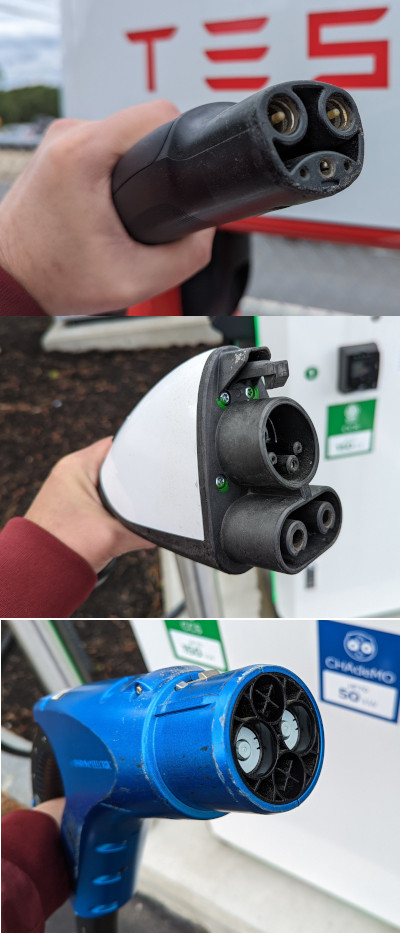
Figure 2: The NACS plug (top) is the smallest and easiest to use of the three DC fast charging plugs in North America. In 2023, most non-Tesla EVs use CCS1 (center); but several automakers have announced plans to switch to NACS. CHAdeMO (bottom) remains available, but CHAdeMO vehicles are poor choices for any but short EV road trips. Note that this comparison photo makes the connectors appear more similar in size than they are because I photographed them to more-or-less fill the frame. Note the size of my had in each of the photos.
Before delving into EV road trip tips and strategies, you should understand the types of connectors that are available. There are three DC fast charging standards in use in North America today, and more than that worldwide. Figure 2 shows the three types of plugs in North America: Tesla, CCS, and CHAdeMO. Tesla uses the same connector for both Supercharger DC fast charging and AC charging at level 1 or level 2. CCS is an expanded version of the J1772 plug that all automakers except Tesla currently use for level 1 and level 2 charging — but read on for information on recent developments! CHAdeMO requires an entirely separate connector from the J1772 connector that CHAdeMO-equipped cars also have.
The trouble with having these three competing standards is that it's easy for an inexperienced EV driver to go to the wrong type of station. As of mid-2023, Tesla Superchargers are useful mainly to Tesla owners. (More on this shortly.) Most stations that support CCS also support CHAdeMO, and vice-versa, so support for these two is mostly correlated, but there are exceptions to this rule. Be sure to set appropriate options in whatever apps or Web sites you use to locate charging stations, so that you aren't directed to a station that provides only plug type(s) you can't use!
Teslas can use adapters to charge at CCS and CHAdeMO stations; however, each of the options has drawbacks:
Recently, the separations between Tesla, CCS, and CHAdeMO plugs have begun to fade. In early 2023, Tesla began experimenting with a way to add CCS support to Superchargers in North America. Called the Magic Dock, Tesla's solution is an adapter that remains tethered to either the Supercharger pedestal or to the end of the cable. As of July of 2023, there are eleven such stations in the United States, two in California and nine in New York State. Initial reports suggest that it works well with most EVs with 400v battery systems, but EVs with 800v batteries (such as most new Hyundai, Kia, Genesis, and Lucid EVs) tend to charge very slowly or have problems initiating a charge. There are also cable-length issues that can create weird parking situations. In particular, Tesla's Superchargers have short cables that are designed to reach a Tesla's charge port on the left rear of the vehicle. Cars that place their charge ports in the right rear or left front must park in the stall to the right of the intended one, effectively occupying two spots. (Sometimes a workaround exists, such as parking to the right of the rightmost stall or using a stall intended for use by Teslas that are towing trailers.) As of a few months ago, Tesla had promised to open about 3,500 of its approximately 21,000 North American stalls to CCS vehicles using the Magic Dock, along with 4,000 slower Level 2 stations; however, Tesla's deals with several automakers (described shortly), and the likelihood that more automakers will follow suit, call the future of Magic Dock into question.
In November of 2022, Tesla renamed its plug the North American Changing Standard (NACS) and invited other companies to use it. At first, this seemed like a publicity stunt; however, on May 25 of 2023, Ford and Tesla jointly announced that Ford owners would gain access to "more than 12,000" Supercharger stalls via adapters in the spring of 2024, and that beginning in 2025, Ford would begin transitioning its cars to use the NACS port. Within weeks, GM, Rivian, Volvo, Polestar, Mercedes-Benz, and Nissan struck similar deals with Tesla. (Nissan's deal covers the Ariya, which ships with a CCS port in North America; but the CHAdeMO-based Leaf does not appear to be included.) In-between the GM and Rivian announcements, a flood of charging equipment providers and DC fast charging networks announced support for NACS. These announcements have sent shock waves through the EV world. The future is still not entirely certain, but most knowledgeable commentators expect CCS to fade in importance and eventually go extinct in North America. The "NACS alliance" automakers together account for over 3/4 of EV sales in North America, and by signing deals for access to Tesla's Supercharger networks, these automakers have bought themselves significant competitive advantages over other automakers. Unless these other automakers make similar deals, they risk being left behind. Note that NACS is a North American standard. It may spread to some other markets, like South Korea; but Europe, Australia, China, and many other places have already standardized on other connectors, which I don't describe on this page.
These announcements change little in the short term for EV road-tripping advice; however, if you own a Ford, GM, Rivian, Volvo, Polestar, or Mercedes-Benz product (or perhaps others in the not-so-distant future), or a Nissan Ariya, you should be able to buy an adapter to enable use of most Superchargers beginning in 2024. Unfortunately, many non-Tesla EVs have charge ports in the left front or right rear of the car. Thus, parking awkwardness similar to what's necessary at Superchargers with Magic Docks may be necessary. (That said, we don't know that for a fact; Tesla might increase the length of cables at some or all Superchargers, or include some extension cable length in the adapters.) Thus, particularly on busy travel days, you may want to favor other charge networks, even if you have an adapter. The adapters will be very helpful in emergencies or on light travel days, though.
Because many third-party charging providers have announced support for NACS, chances are we'll begin seeing third-party charge stations with both CCS and NACS plugs show up in late 2023 or 2024. In fact, Texas, Washington State, and Kentucky are all mandating such dual-port configurations for deployments that use National EV Infrastructure (NEVI) funds in their states. Such deployments will be useful both to Teslas and to non-Tesla EVs with NACS connectors. Chances are that Teslas will need CCS communications support to use such plugs, though, so you may want to get that upgrade if you own an older Tesla.
In sum, in 2023 there are three types of DC fast charging plugs in North America, although CHAdeMO is nearly defunct and isn't used by any good road-trip vehicles. The future is uncertain, but NACS is likely to become the standard. I do not recommend delaying a purchase, though, since the transition will take years and CCS support will continue for that time. That said, if you're in the market for an EV and road-tripping is important to you, you should favor EVs that use NACS, or that are CCS vehicles from manufacturers that have announced that they're switching to NACS and that will provide adapters to enable their CCS vehicles to charge at Superchargers. Buying such a vehicle will guarantee its continued viability in the indefinite future.
How do the principles of EV design and charging affect the reality of a road trip? This section covers the most important things you can do to improve an EV road trip experience. The next section, Looking After the Little Things, covers more minor tips. In broad strokes, the most important tips are:
Before you begin your trip, it's important that you pick the right car. The early compliance EVs with ~100-mile range just are not up to the task for most people. Even many of the earlier attempts at EVs with 200+ miles of range, like the 2017 Nissan Leaf e+ (226 miles) or the Chevy Bolt (238 or 258 miles, depending on year) aren't the best choice, thanks to limited DC fast charging capabilities.
Just how capable the car must be depends largely on you. If you enjoy stopping every hour to see the sights, then even an old compliance car might be adequate. If you drive in shifts with somebody else and like to stop for ten minutes to use the bathroom, eating food you brought with you from home while driving in the car, then even today's best EVs might not be up to the job. For most people, though, I'd say that a 250-mile range and 75–100 kW DC fast charging capabilities are the bare minimum for a small EV that won't be overly frustrating. Note that's the bare minimum; a car that meets those specifications, like the Hyundai Kona EV (258-mile range, 75 kW DC fast charging), might cause road trips even in fairly optimal conditions to be slowed by a small amount — maybe adding half an hour or an hour per day to a trip. As the car's size goes up, and therefore its energy efficiency down, the minimum acceptable DC fast charging speed goes up. The Kona is a small and efficient car, which gets 3.6 mi/kWh. A larger and less efficient vehicle, like the Ford Mustang Mach-E (3.1 mi/kWh), would require a faster DC fast charging rate. The new EV pickup trucks are even less efficient — the Ford F-150 Lightning, for instance, gets only 2.0 mi/kWh, so it would need to charge at 132 kW to match the Kona's range gain at 75 kW, all other things being equal. (Depending on the variant, the F-150 tops out at 120 kW or 155 kW, so it's in the Kona's ball park in terms of miles gained per minute of charging, assuming similar charge curves.)
Teslas have a reputation as being more road-trippable than other EVs. Partly this is because Teslas have historically had significantly higher DC fast charging rates than competing vehicles; but this advantage also has to do with the nature of Tesla's Supercharger network, which I'll describe shortly. In terms of the in-car charging capability, Teslas remain competitive in 2023, but they're no longer head-and-shoulders above the competition. For instance, the Tesla Model Y tops out at 250 kW, whereas the competing Kia EV6, at least with its longer-range battery, tops out at 240 kW. The Tesla is a little more energy-effient, though, which helps.

Figure 3: CCS DC fast chargers in the state of Wyoming in June of 2022
Before buying an EV, you should also consider the road trip routes you're likely to take. The route-planning software described shortly can be very helpful in doing this. Researching charging opportunities along your route is also important before embarking on a road trip, particularly into areas through which you've never traveled before in an EV. The reason for this is that DC fast charging infrastructure is still not as prevalent in the US as is ICE fueling infrastructure. This means that there are areas with sparse or even nonexistent DC fast charging infrastructure. For instance, consider Figure 3, which shows a map of Wyoming's CCS infrastructure, as reported by the PlugShare Web site in June of 2022. This map shows eight sites within the state, but four of them (with the wrench icon) were marked as "coming soon." (Two sites, in Cheyenne, are so close together that their markers largely overlap on the map at this scale.) Traveling through Wyoming in 2022 in a CCS vehicle would have been very difficult indeed. (For comparison, the state of Rhode Island [1,214 sq. mi.] had 18 CCS stations in 2022, compared to the 8 in Wymoming's 97,914 sq. mi.)

Figure 4: CCS DC fast chargers in the state of Wyoming in June of 2023
Keep in mind, though, that infrastructure is constantly improving. Compare Figure 3 to Figure 4, which shows the state of Wyoming's CCS infrastructure in June of 2023, one year after the snapshot of Figure 3. The number of stations has more than doubled, with stations previously marked as "coming soon" now online and new stations appearing (some marked "coming soon," but some already active).
Even if you live in areas that show lots of DC fast chargers in tools like PlugShare, you may have difficulty traveling if those fast chargers are of the barely-fast variety. This was a problem with the Fox Business article I referenced earlier; the author tried to travel in a Kia EV6 (capable of charging at 240 kW) through areas that were served by 50 kW, or even 24 kW, DC fast chargers. The result, as you might expect, was disastrous.
Route-planning software, described shortly, can help you pick good charging stops. Sometimes, though, you must deviate from what such software suggests; or you may need to find charging when you're at your destination. In this case, how can you find a good place to charge? Most charging network providers (Electrify America, EVgo, ChargePoint, and so on) offer apps that can help you find their chargers. The PlugShare app and Web site, though, is my preference, since it provides information on all charging stations regardless of network. If you're mid-trip, be sure to check the entries for the network associations and maximum charge speeds of the locations. You can also review the site's reliability. PlugShare provides ratings, between 1.0 and 10.0, based on successful vs. unsuccessful recent check-ins. You can also read comments provided with those check-ins, which may help you avoid problems — for instance, comments may note that a particular charging stall is inoperative, but others work fine. You can help others by providing your own check-ins on PlugShare.
The three largest CCS networks in North America are Electrify America (EA for short), EVgo, and ChargePoint. EVgo and ChargePoint installations have historically been focused on cities and suburbs, whereas EA has aimed to emulate Tesla's goal of enabling inter-city travel. Thus, EA has been the go-to network for road trips. This may be changing, though. In July of 2022, EVgo, GM and Pilot/Flying-J announced a partnership to bring EVgo DC fast chargers to Pilot and Flying-J travel plazas.
Unfortunately, none of the CCS network providers has established a reputation for great reliability. The Rate Your Charge Twitter thread aims to collect charger ratings, and presents a summary at the top of the thread. In June of 2023, it shows Tesla's Supercharger network with a commanding lead over CCS networks, on the whole. (ChargePoint looks fairly good, but there are relatively few ratings for it.) PlugShare ratings of these networks, although harder to quantify nationwide, are far below those achieved by Tesla's Supercharger network. This isn't to say that the CCS networks are unusable; but you should be aware of the fact that problems may arise at many of these stations, and plan accordingly. Check PlugShare ratings before going to one of these sites, and try not to arrive with a SoC so low that you can't make it to another charging station, should the need arise.
Tesla's Supercharger network remains superior to the network of multiple third-party CCS charging stations used by other EVs. This fact makes a Tesla an appealing choice if you intend to take frequent road trips in an EV. That said, both types of networks are being built out, and interoperability is looking likely in the future, as described earlier, in Considering Charge Port Types
Fortunately, route-planning software can help you find charging on a road trip. To the best of my knowledge, the best such tool is A Better Routeplanner (ABRP), which is available as both a Web site and an app (for both iOS and Android). To use ABRP, you tell it what car you're driving, enter starting and ending points, and click the button to plan the route. The tool then creates a list of charging stops, and you can export its plan to Google Maps. You can customize ABRP with information on expected weather conditions, your preferred driving speed, and so on. You can also input waypoints, including overnight stops where you can tell ABRP about your level 1 or level 2 charging plans. ABRP knows about the maximum charge rates of the stations in its database, so it can route you to a faster DC fast charger, avoiding the old 24 kW or 50 kW units.
EVs are increasingly incorporating information about DC fast charging options in their in-dash navigation systems. The best of these, like the one included in Tesla's navigation system, are quite capable and can be used instead of ABRP. Some, however, remain deficient and should not be relied upon. I've heard of systems that attempt to route travelers to level 2 EVSEs rather than DC fast chargers for some stops!
I strongly recommend consulting ABRP before beginning a trip. Doing so will obviate the need to study dozens of PlugShare entries to be sure you're not driving into an EV charging desert; or if doing so is unavoidable, ABRP will help you optimize a path through it. Rachel Wolfe, the author of the Fox Business article I mentioned earlier, failed to heed ABRP's advice on her trip. As a result, she drove straight through a route served only by 24 kW and 50 kW DC fast chargers. Had she followed ABRP's plan, she would have traveled an extra 70 miles or so, but saved herself two or three hours of charging time. Don't make the same mistake yourself!
The preceding suggestions will help you implement a successful EV road trip. There are, however, a few smaller details you might want to consider, too:

Figure 5: RIP bugs.
EVs need much smaller front grilles for radiators than do ICE vehicles. Therefore, although it's not something you need be concerned with while on the road, be aware that EVs' front ends become bug graveyards after road trips in the summer, as shown in Figure 5. You will probably want to spend extra time cleaning away the bug carcasses after your trip. My experience is that car washes do an incomplete job of this task, at best.
I find that I usually have enough charge toward the end of a road trip that I might not need to charge at the final stop I take for my own needs. I can instead charge fully overnight when I return home, and at lower cost than using most DC fast chargers I might use for that final on-road charge. Of course, if you lack the ability to do a level 2 charge at home, you might need to charge up to a moderately high value before returning home.
I've been focusing on how to do an EV road trip properly on this page; however, as I've already noted, there are reports, even in national news media, about road trips gone awry. Often these news reports describe how awful the EV road trip was without really acknowledging that it could have been better. Although ignorance is understandable and excusable in an average driver, it's my goal in writing this page to dispel some of the misconceptions and steer people clear of mistakes. To that end, here are some mistakes you should avoid on an EV road trip:
Many of these mistakes are basically the opposites of things you should do. Still, they deserve pointing out because I've seen multiple accounts of people making these mistakes. In fact, I've made some of them myself! Sometimes violating one of these rules causes few or no real problems; but other times, it makes what should be a simple road trip a nightmare.
One thing that might be unavoidable is driving through areas with poor DC fast charging support. If you really want to drive through Wyoming in your brand-new Ford Mustang Mach-E for instance, you'll just have to deal with its huge CCS desert. (At least, in 2023. As noted earlier, DC fast charging infrastructure is improving rapidly.) Of course, if you know your trip will involve a DC fast charging desert, you might want to consider renting a gas vehicle instead of taking your EV. If that desert is small enough, though, careful planning can help. You might be able to schedule an overnight stop at a hotel with a level 2 EVSE in the middle of the DC fast charging desert, for instance. Similarly, charging to a high SoC (maybe even 100%) can help you push through it.
Contrary to some news reports, EV road trips in 2023 are quite possible, and even easy, with a few caveats:
Currently, EVs are moving from a bleeding-edge technology to a mainstream technology for daily driving. They're very practical commuter cars for people who own their own homes or have some way to charge on a regular basis, and who can afford the initial up-front cost. (That cost is coming down, but it's still above the cost of similar ICE vehicles, at least for new cars. Total cost of ownership can be lower for an EV than for an ICE car, though.) Although EVs still aren't suitable for everybody, even for daily driving, they're good choices for many people for this purpose.
For road trips, EVs cover the range from impractical (for older compliance cars) to bleeding-edge (for various conditions described on this page) to fully practical (for the best road-trip EVs on well-supported routes). Driver knowledge is an important part of moving an EV into this final category. The information on this page should help you make your EV as practical as it can be for a road trip. As EVs improve (greater range, faster DC fast charging capabilities, better in-dash navigation tools) and as infrastructure improves (more, faster, and more reliable DC fast charging stations), EVs will become more practical. Even an EV bought today will be a better road-trip machine in a year or two, as infrastructure improves.
EV road trips are a popular topic of discussion in online forums, in EV car reviews, and in YouTube videos. There are also online resources that may be helpful if you're interested in a particular EV model or DC fast charging generally. This section provides pointers to sites and videos I've found helpful.
Keep in mind that things are changing rapidly in the EV world. Even the four-year-old videos and Web pages cited above are getting a little long in the tooth now, in 2023. I bought my Tesla in March of 2019, and in the half year or so before I bought it, I did considerable research on the feasibility of doing EV road trips from my home in Rhode Island to Ohio. During that half-year period, things changed considerably, especially for CCS vehicles; stations came online that made certain routes possible in early 2019 that would not have been possible in mid-2018. As more DC fast chargers are installed today, the same will be true for other routes — perhaps some that are of interest to you.
copyright © 2022–2023 by Roderick W. Smith
If you have problems with or comments about this Web page, please e-mail me at rodsmith@rodsbooks.com. Thanks.
Return to my main Web page.